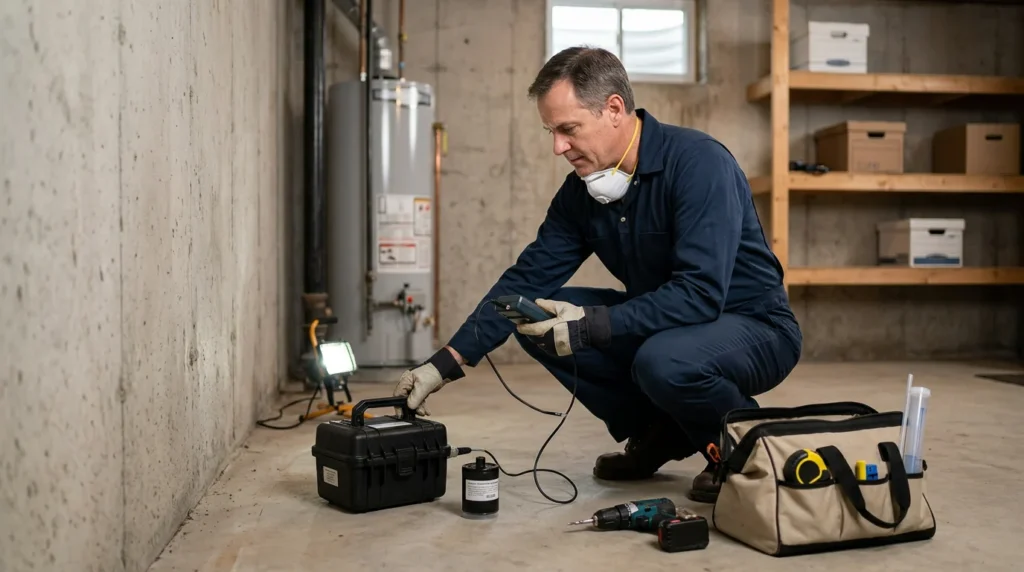
Quick answer: Yes, radon testing is a smart step before buying a home because radon is an invisible, odorless gas that can build up indoors and raise long-term health risk. You can’t reliably predict levels from the neighborhood, the home’s age, or whether it has a basement. A short-term test during due diligence can show if the result is at or above the EPA action level (4.0 pCi/L) and whether mitigation should be part of the deal.
What Radon Testing Tells You (And What It Doesn’t)
A proper radon testing measures the radon concentration in the home’s air over a set period, usually with a short-term device placed in the lowest livable level. It answers one key question: is the result high enough that you should plan on mitigation? Because radon can fluctuate day to day, the goal is to get a representative snapshot under standard “closed-house” conditions.
It doesn’t tell you exactly where the radon is entering, and it can’t guarantee future levels will never change. Weather, HVAC operation, and how often doors and windows are opened all affect readings. That’s why placement, timing, and following the test protocol matter as much as the device itself.
Standards & Protocol
General guidance for real estate radon testing commonly follows U.S. EPA recommendations and consensus standards such as ANSI/AARST. These references describe “closed-house” conditions (keeping windows closed and limiting exterior door openings except normal entry/exit), typical short-term test duration (often about 48 hours), and device placement rules meant to reduce biased results.
They also spell out practical placement basics: test in the lowest level that could be occupied, position the device in a normal breathing zone (not on the floor), and keep it away from drafts, exterior doors, direct sunlight, high heat, and excess moisture. If you want to read the source guidance directly, look up the EPA’s radon testing guidance and the ANSI/AARST radon measurement standards.
How to Use the Number: Common Thresholds and Buyer Actions
General guidance uses picocuries per liter (pCi/L) in the U.S. The EPA action level is 4.0 pCi/L. Many buyers treat results at or above 4.0 pCi/L as a trigger to negotiate a mitigation system (or a credit) and then confirm performance with a post-mitigation test. Results well below 4.0 pCi/L are often accepted with no immediate action.
Borderline results (for example, roughly 2.0–3.9 pCi/L) are where decision-making matters. The EPA also encourages considering mitigation at 2.0 pCi/L and above, especially if you plan to use the lowest level frequently or finish a basement later. If timing allows, some buyers choose a longer-term test for a more stable average; if timing doesn’t allow, they may proceed and plan mitigation based on risk tolerance and intended use of the space.
One more practical point: a “low” result doesn’t mean “no radon forever.” Retesting after major changes—finishing a basement, adding significant air-sealing, or replacing HVAC—can catch shifts in how the home moves air and soil gases.
What You’ll Receive
A radon test report should give you enough detail to make a clean decision and to document what was done. In general, expect to see the device type category (for example, continuous radon monitor vs. passive charcoal), the start and stop times (test duration), and the recorded placement location (level of the home and room/area).
The report should also state the result in pCi/L, include a plain-language interpretation against common guidance (including the 4.0 pCi/L EPA action level), and list recommended next steps such as “no action,” “retest,” “consider long-term testing,” or “mitigation and post-mitigation verification.” If you want help ordering the right test and reading the report in plain language, BluePrint Home Inspection can help.