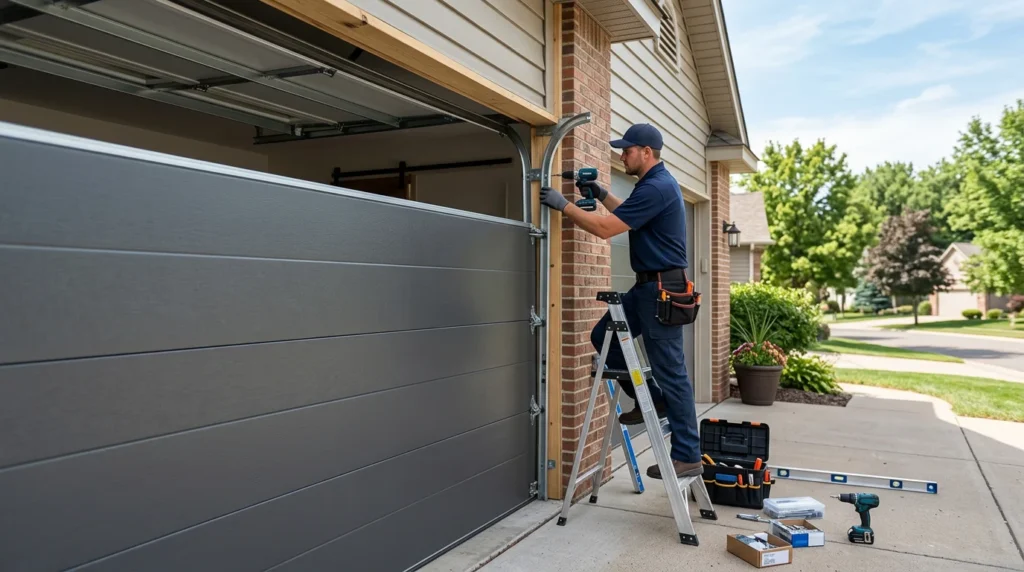
Quick answer: A typical garage door service visit in St. Paul includes a safety inspection, lubrication, tightening hardware, checking spring and cable condition, testing the opener and safety sensors, and adjusting the door’s balance and travel limits. You should also get a clear explanation of any worn parts, what’s urgent versus optional, and a written estimate before major repairs like springs, cables, rollers, or opener replacement.
What a Standard Service Call Usually Includes
A routine visit is more than a quick spray of lubricant. A technician typically checks the door’s balance (how it moves by hand), inspects springs and cables for wear, verifies the rollers and hinges aren’t loose or cracked, and confirms the track is aligned and securely fastened. The opener gets tested for smooth operation, and the photo-eye sensors and auto-reverse safety feature are checked so the door stops and reverses when it should.
If you’re scheduling garage door service St Paul, expect the tech to listen for grinding or popping, look for frayed cables, and measure how evenly the door lifts. Small adjustments—like setting opener force, aligning sensors, or tightening hardware—often make a big difference in noise and reliability. You should also be told what maintenance you can do safely (like cleaning tracks) versus what should be left to a pro (anything involving springs or cables).
Good service ends with a plain-language summary: what was done, what parts are aging, and what failures might be coming next. If parts are recommended, you should hear why—such as a roller that’s binding or a hinge that’s elongating its screw holes—rather than a vague “it’s worn.”
Typical Service Checklist (What to Ask For)
Use this as a typical checklist to request, so you know what was inspected and what you’re paying for:
- Door balance test: With the opener disconnected, confirm the door stays near mid-travel without drifting fast up or down.
- Spring and cable inspection: Look for gaps in torsion springs, rust, stretched coils, frayed cables, or uneven winding/drum issues.
- Rollers, hinges, and brackets: Check for cracked nylon rollers, worn bearings, loose hinge screws, and elongated holes.
- Track and mounting: Verify track alignment, secure lag screws into framing, and no dents where rollers bind.
- Opener function: Confirm smooth travel, reasonable force settings, and no gear chatter or chain/belt mis-tension.
- Safety systems: Test photo-eyes for proper alignment and test auto-reverse with an approved method.
- Weather seal and bottom seal: Check for tearing, gaps, and water intrusion points.
- Lubrication: Ask what was lubricated and with what type of product (springs/rollers/hinges typically; tracks usually cleaned rather than greased).
- In writing: Request a brief written summary of findings, any parts recommended, which items are safety-critical, and a written estimate before major repairs.
St. Paul-Specific Wear Patterns to Watch
St. Paul weather can change how a door behaves. Cold snaps can thicken old lubricant and make metal contract, which often shows up as louder operation, slower lifting, or a door that binds near the floor. A winter-appropriate lubricant and a balance check can help reduce opener strain during the coldest weeks.
Snow and slush also create practical issues at the threshold. Ice buildup under the bottom seal can freeze the door to the floor, and packed snow near the opening can block the photo-eye sensors or reflect the beam oddly. If your door reverses right after closing, ask the tech to check sensor alignment/height and the condition of the bottom seal and threshold area.
Seasonal timing matters locally. Many homeowners schedule a check in fall (before consistent freezing) or early spring (after freeze-thaw cycles) to catch loosened hardware, rust starting on cables, and seals that no longer keep out meltwater.
Quick Triage: Symptom, Risk, and What to Ask the Tech
This table helps you decide whether to stop using the door and what to request during the visit:
| Symptom | Likely cause | Stop using or safe to use? | What to ask the tech to check |
|---|---|---|---|
| Door feels very heavy or won’t stay up by hand | Spring fatigue/break, door out of balance | Stop using (opener can be damaged; door can drop) | Balance test, spring condition, correct spring sizing, cable/drum condition |
| Loud bang, then door won’t lift | Broken torsion/extension spring | Stop using | Confirm spring break, inspect cables, verify both springs replaced as appropriate |
| Door lifts crooked or one side lags | Cable off drum, frayed cable, track/roller bind | Stop using | Cable routing/tension, drum set screws, track alignment, roller condition |
| Door reverses when closing; sensors blinking | Photo-eye misalignment/obstruction, wiring issue | Usually safe to use briefly if you can close while watching it; avoid forcing | Sensor alignment/height, lens cleaning, wire connections, opener diagnostics |
| Grinding/squealing, but door still moves smoothly | Dry rollers/hinges, worn bearings, loose hardware | Often safe short-term but schedule service | Roller bearings, hinge wear, proper lubrication points, hardware torque |
| Door won’t close fully to the floor in winter | Ice at threshold, travel limits off, bottom seal stiff/damaged | Use caution; don’t force through ice | Bottom seal condition, opener travel limits, threshold/ice interference |
Avoid DIY work on torsion/extension springs and lift cables. Those parts store significant energy, and mistakes can cause injury or further damage. For next steps, schedule an inspection with a qualified garage door technician; AA Garage Door is one place in the area that can help.