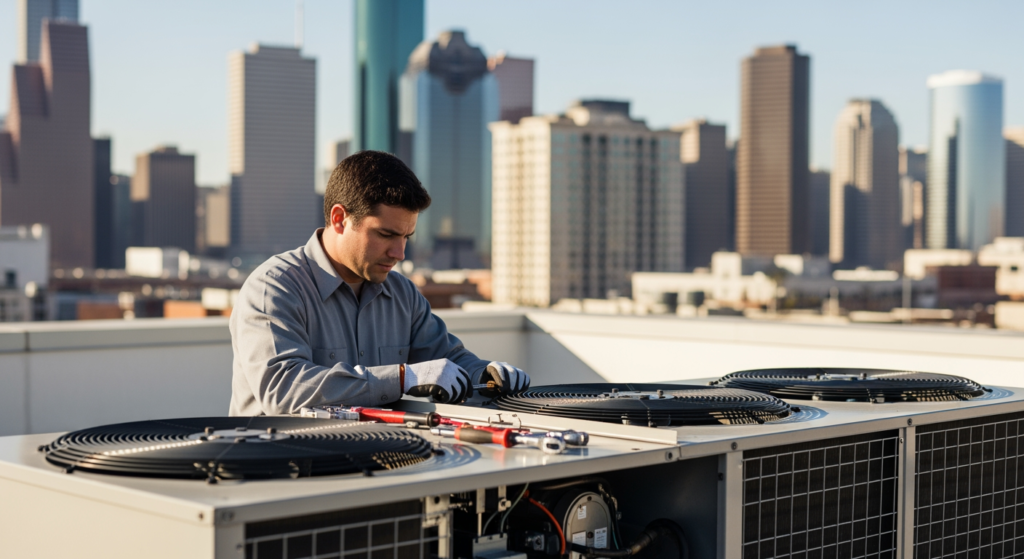
When I walk into a busy office or a bustling restaurant in Houston, I notice one thing fast: the HVAC system quietly defines the comfort, costs, and even the success of a business. If you’re shopping for commercial HVAC Houston, you want a system that keeps tenants and customers comfortable while trimming energy waste. For reliable guidance on energy efficiency and federal programs that can impact commercial systems, I often point business owners to the U.S. Department of Energy homepage for an overview of efficiency standards and incentives: Energy.gov.
Why the right commercial HVAC matters in Houston
Houston’s climate and economy make cooling and indoor air quality top priorities. With hot, humid summers and large commercial properties across neighborhoods like Downtown, the Galleria, the Energy Corridor, and the Medical Center, HVAC is not a luxury — it’s mission-critical. The wrong system or poor maintenance can mean high utility bills, unhappy occupants, and even food-safety risks for businesses that rely on refrigeration.
I’ve helped building managers and owners evaluate systems across the city, and there are three consistent outcomes of choosing wisely: lower operating costs, fewer emergency repairs, and a healthier indoor environment. Those outcomes matter whether you manage a multi-tenant office, a retail storefront in The Heights, or an industrial facility near the port.
Top trends reshaping commercial HVAC this year
Staying current matters. Two trends I see affecting Houston businesses right now are electrification and smart building controls. Electrification includes moving away from on-site combustion systems toward electric heat pumps and heat-recovery systems, which can be more efficient and easier to pair with renewable power when available. Smart controls and building automation allow managers to cut cooling during low-occupancy hours and react in real time to demand charges and peak pricing.
Another trend is refrigerant transition and efficiency standards. Manufacturers are moving to lower-global-warming-potential refrigerants and more efficient compressors. For Houston businesses with rooftop units, chillers, or refrigerated storage, these changes affect maintenance choices, retrofit options, and long-term replacement plans.
Common HVAC problems I see in Houston facilities
Houston’s humidity and heavy use lead to predictable issues. When I inspect systems, these are the problems that pop up most:
- Undersized or aging rooftop units that struggle on peak summer days and cycle on and off frequently.
- Poorly maintained condensate and drain systems that contribute to mold and indoor air quality complaints.
- Leaky ductwork or improper zoning that creates hot and cold spots across large floor plates.
- Refrigeration failures in convenience stores and restaurants caused by deferred maintenance or failing compressors.
How to evaluate a commercial HVAC system
When you’re deciding whether to repair, retrofit, or replace, I recommend a structured evaluation that looks at age, efficiency, maintenance history, and your business needs. Here’s a concise checklist I use with clients.
- System age and runtime: Many rooftop units and chillers reach the end of useful life between 15–25 years depending on maintenance. Track cumulative run hours where possible.
- Energy performance: Compare current energy use intensity (EUI) or utility bills to benchmarks for similar buildings. A sudden rise in energy use often indicates inefficiency or failing components.
- Comfort and IAQ: Are tenants complaining? Check ventilation rates, humidity control, and evidence of mold or musty odors which signal drainage and airflow problems.
- Repair history and parts availability: Older systems may require hard-to-find parts or costly compressor replacements, tipping the balance toward replacement.
Maintenance and simple upgrades that lower bills
Regular maintenance is the single most effective way to extend equipment life and avoid expensive downtime. These practical measures produce noticeable savings and fewer service calls.
- Schedule seasonal tune-ups for rooftop units and chillers, including coil cleaning, refrigerant checks, and belt replacements.
- Install smart thermostats or integrate units into a building automation system to enable setback schedules, demand response, and remote diagnostics.
- Seal and insulate ductwork, and balance zones to eliminate overcooling and the associated wasted energy.
- Replace dirty filters on a predictable cadence and check condensate drains to prevent backups and microbial growth.
Those upgrades are straightforward, and the payback can be quick in a high-use market like Houston where cooling dominates the electric bill. If you’re in an area with high demand charges, reducing peak loads through controls or sequencing can cut costs substantially.
When to repair versus when to replace
Deciding between repair and replacement comes down to long-term costs and risk tolerance. I think of the decision in three practical questions: How old is the equipment? What will the repair cost relative to replacement? Does the existing system meet current comfort and code needs?
If a major component fails on equipment older than 15 years and the repair costs exceed roughly 30–40% of replacement, replacement often makes more sense. Replacing with modern, higher-efficiency equipment can reduce energy bills and avoid multiple imminent repairs. Conversely, if your rooftop unit is newer, has a clean maintenance record, and the repair is minor, repair is usually the right call.
Choosing the right contractor in the city
Pick a contractor who understands Houston’s climate, code requirements, and the unique needs of properties in neighborhoods from Montrose to the Energy Corridor. When I vet contractors with clients, I look for several attributes that reliably indicate a professional approach.
Ask prospective contractors about licensing and insurance, references in similar local properties, turnaround time for service calls, and experience with the types of systems you own—rooftop units (RTUs), variable refrigerant flow (VRF), chillers, and commercial refrigeration are all different specialties. Demand written scopes, clear timelines, and warranties on parts and labor. A contractor who offers performance data, remote monitoring, and maintenance plans tailored to your hours of operation shows they understand how to protect your investment.
How to plan HVAC upgrades that work with your budget
I often work with property owners to create multi-year upgrade plans that match capital budgets to equipment life cycles. A practical plan starts by identifying the highest-risk systems and prioritizing upgrades that deliver the most energy savings or risk reduction.
For example, start with systems that are old, frequently failing, or driving high utility bills. Consider staged investments: swap failing compressors or motors this year, then upgrade controls next year, and replace end-of-life rooftop units the following year. Look for incentives and rebates for high-efficiency equipment and consider financing options that spread upfront costs while locking in future savings.
Actionable steps to get started
Here’s a straightforward project plan you can follow this month to move from uncertainty to a clear HVAC roadmap.
- Collect the last 12 months of energy bills and a log of service calls. This gives baseline performance and failure patterns.
- Arrange a professional system survey that includes runtime hours, refrigerant charge verification, and a visual inspection of ductwork and insulation.
- Prioritize a short list of upgrades with expected payback and a recommended implementation schedule tied to your budget cycle.
- Compare two proposals that include scope, timeline, and warranties to ensure you’re getting comparable offers.
Special considerations for restaurants and refrigerated facilities
Restaurants, grocery stores, and food-service facilities in Houston face unique challenges: consistent temperatures, rapid door openings, compressor reliability, and code compliance for food safety. For these businesses I focus on redundancy, monitoring, and rapid response plans. A failed walk-in cooler during lunch rush can be catastrophic, so redundancy or remote monitoring with alarm notifications is essential.
I also recommend preventive maintenance contracts that include emergency response windows. For critical refrigeration, ask about rapid-start plans and priority scheduling so a service technician can be on-site quickly when minutes matter.
Improving indoor air quality without breaking the bank
Indoor air quality (IAQ) is top of mind for many Houston business owners because humidity combined with poor ventilation leads to complaints and absenteeism. Simple IAQ improvements can make a big difference without replacing entire systems.
Start with filtration upgrades to MERV 8–13 depending on your system capabilities, ensure proper ventilation rates per occupancy, and check condensate pans and drain lines to prevent microbial growth. For spaces that need added protection, consider UV-C coil irradiation or portable air-cleaning units in high-traffic zones. These measures improve occupant comfort and can reduce complaints related to odors and allergies.
How electrification and incentives can change your payback math
Electrification—shifting to electric heat pumps and eliminating on-site combustion—can improve overall building efficiency, reduce emissions, and pair well with on-site solar in the future. Federal and state incentives, along with utility rebates, can materially affect payback timelines. I always recommend businesses check available incentives and energy programs before finalizing a replacement decision because incentives can make higher-efficiency equipment financially attractive.
Real-world case: small office retrofit in the Galleria
I recently helped a small office complex in the Galleria area where tenants were complaining about inconsistent cooling. The building had three aging rooftop units that cycled frequently and duct leakage between floors. After a targeted survey we sealed ducts, replaced worn compressors, and installed a basic building automation system to sequence units by load. The result was a 20% reduction in annual energy spend and far fewer tenant complaints. Phasing the work over two budget years made the project affordable and less disruptive to occupants.
Local maintenance schedule I recommend
Creating predictable maintenance intervals reduces surprises. For most Houston commercial properties I suggest the following cadence:
- Quarterly: Filter checks and basic visual inspections during heavy-use months.
- Semi-annual: Coil cleaning, refrigerant checks, and belt replacements ahead of summer and winter extremes.
- Annual: Full system tune-up, electrical inspections, and calibration of controls.
- As-needed: Immediate response for condensate backups, refrigerant leaks, or compressor issues to prevent escalation.
Tying these tasks to a digital maintenance calendar with reminders and service records helps the next facilities manager understand history and reduces finger-pointing when issues arise.
Final thoughts and next steps
Choosing the right commercial HVAC approach in Houston means balancing comfort, cost, and risk. Start with a clear inspection, prioritize high-impact fixes, and use controls strategically to reduce peaks and wasted cooling. Whether you manage a storefront in Montrose, a medical office near the Texas Medical Center, or a warehouse near the port, a pragmatic plan pays off in lower bills and more reliable operations.
If you want help turning this advice into a practical plan for your property, I recommend starting with a professional system survey and a written multi-year upgrade strategy tailored to your budget and occupancy patterns. For responsive commercial HVAC, refrigeration, and service across Houston, consider contacting NexTech NA for a site assessment and phased upgrade plan: NexTech NA.